Learn more
-
This project has a Cherokee Nation advisor and Cherokee Nation interviewer/researcher, alongside a Mohawk author. Their work is joined by interviewee voices from Lenape, Chickasaw, Onondaga, Passamaquoddy, Eastern Band of Cherokee, United Keetoowah Band Cherokee, Ojibwe, Seneca, Abenaki, and Menominee communities, with others still to come.
-
Dr. Courtney Lewis (Advisor): Associate Professor Courtney Lewis (Ph.D., UNC Chapel Hill, 2012) is an enrolled citizen of the Cherokee Nation, who has established herself as a rising star in Native American Studies as well as a dynamic program builder. Her research explores the themes of Native sovereignty, economic justice, and the ethnography of tribal capitalism, focusing on small businesses in the Cherokee Qualla Boundary in the North Carolina mountains. By contrast to the feathers-and-beads mythologies of native peoples as stuck in a buffalo-hunting time-warp and, conversely, racist tropes about them as lazy dependents of the government, Lewis shows how Cherokee business owners struggle with factors general to capitalist America and specific to Indian experience to make their way forward. She brings her economics background to the task, combining a careful eye for cultural processes with an attentiveness to markets and capital. Her prize-winning book, Sovereign Entrepreneurs: Cherokee Small-Business owners and the Making of Economic Sovereignty (UNC Press) is driven by a powerful sense of moral as well as scholarly engagement with issues of social justice and native sovereignty insofar as developing tribal businesses is a key aspect of 21st century American Indian life. The book is regarded as one of the most original anthropology books about Native America today. Dr. Lewis’ developing research addresses American Indian food sovereignty.
Neftalí Duran (Chef/Author): Neftalí Duran is a community cook, advocate, educator, and organizer, working towards an equitable food system and building a network of Indigenous food leaders. He is the co-founder of the I- Collective, an Indigenous collective that promotes a healthy food system that values people, traditional knowledge, and the planet over profit; as well as the Holyoke Food and Equity Collective, a local group of volunteers working toward food access in Holyoke, where he presently resides. His writing and culinary projects have been featured at the Smithsonian Native American museum, the Smithsonian museum of American history, the Native American Culinary Association, LongHouse Food Revival, Food52, Food and Wine Magazine, and the Cooking Channel, and he has been a featured speaker at The Moth mainstage, Harvard, Smith College and more. Neftalí’s work is grounded in the belief that access to food is a human right. Neftalí’s work is informed by his own experience as an Indigenous (ñuu savi) and formerly undocumented migrant worker and 20 years of experience in the restaurant and food industry as chef, baker, and small business owner. He engages in grassroots work and advocacy regarding Indigenous culinary traditions, the effects of migration on people and food, and the environment. His interests include documenting the culinary traditions of the different regions of Oaxaca, Mexico, reclaiming the roots and culture of the original peoples of the Americas, having conversations about the impact of colonialism in our communities in regards to traditional food-ways, and engaging in conversations about the impact of climate change on frontline communities. His current work is focused on community-based environmental work in Oaxaca, including an active reforestation project.
Stephanie Morningstar (She/They) (Author): Stephanie is Mohawk with her mother’s ancestors rooted in Six Nations of the Grand River Territory (Schuler/Hope/Powless) and her father’s ancestors from Western and Eastern Europe. She is a plant nerd, medicine tender, bridge builder, soil and seed steward, scholar, student, and Earth Worker dedicated to decolonizing and liberating minds, hearts, and land- one plant, person, ecosystem, and non-human being at a time. She loves to learn and share stories about medicines; builds soil and reintegrates mycelium at Sky World Apothecary and Farm; teaches about the plant-human-non-human-ancestral connection through a decolonial lens at Seed, Soil, + Spirit School; and liberates land with and for Indigenous, Black, and people of color as the Relationships and Reciprocity Co-Director at the Northeast Farmers of Color Land Trust. Stephanie is a Ph.D. student in the Interdisciplinary Environmental Studies Graduate Program focusing her work on Biocultural Re-storyation at the SUNY College of Environmental Sciences and Forestry’s Center for Native Peoples and the Environment.
Eric Toensmeier (Author): Eric Toensmeier is the award-winning author of many books including Edible Forests Gardens, The Carbon Farming Solution, and Paradise Lot. He has studied and grown useful plants for over three decades. He writes, consults, teaches, and operates a small agroforestry farm.
Catherine Webb (Lead Interviewer): Catherine Webb (b. 2000) is a visual artist and a recent graduate of Yale University, where she double majored in Studio Art and Environmental Justice. Catherine grew up in Southern California and is a citizen of the Cherokee Nation in Oklahoma. Catherine’s passion for Indigenous foodways and food sovereignty activism began when she stewarded a Three Sisters garden as her high-school Senior Capstone Project. At Yale, she served as the inaugural seedkeeper and the Seedkeeper and Programs Liaison between the Yale Sustainable Food Program and the Native American Cultural Center for five years. Catherine acted as a moderator, panelist, poet, educator, cook, speaker, and steward in this role. Outside of Yale, she has worked in cross-cutting sectors, including the National Park Service, an Indigenous art installation, academic research, food service, and nonprofit and for-profit organizations. Catherine is committed to caring for the land and future generations. For Catherine, painting is a creative medium to imagine more just futures for all people and is a practice to sustain herself as she advocates for change-making. Catherine has been chosen to participate in two art residencies over the next two years and is painting intensively before returning to environmental justice advocacy work.
Aba Kiser (Administrative Project Support) Aba Kiser founded Watershed Productions to bring together her passion for food, plants, production and equitable storytelling. She has worked as the Program Manager for the state-wide Washington State University Food Systems Program for nearly a decade, working closely with the Culinary Breeding Network across the Pacific Northwest and abroad. In 2020 she was named Capital Press’ Western Innovator for her commitment to equity. Aba is also a musician and brings a kaleidoscope of technical skills to her production work including audio, video, photography, mixed media, performance and event production. She currently lives on Piscatoway land in Maryland where she builds soil in her no till garden in between her role as the Assistant Director of Outreach at the Organic Seed Alliance.
-
Our book focuses on the vast forested region east of the prairies, south of the boreal forest, and north of tropical parts of Florida. This area is almost exactly the same as the native range of the wild black cherry. It shares a great many of the same plant species. Historically it featured similar historic Indigenous farming, gardening, and landscape curation practices.
-
While we wish we could interview and showcase voices from every Native Nation east of the prairie, our project is not designed to be a comprehensive representation of all Indigenous voices in the Eastern forest region. We have interviewed 12+ enrolled Indigenous individuals from Native Nations that span the Eastern forest region, with a few more to come. Our literature research covered the region as broadly as we were able, for people whose current and historic range is within the region. For example, we provide names for the plants in sixty-two languages - all that we could find. Our interviewees were chosen in part to represent individuals and Nations from throughout the region’s geography. We also include previously published quotes from Indigenous people across the region from additional 8+ Nations.
-
Indigenous agriculture and the curation of “wild” plants and ecosystems of the Eastern forest region. This project has been envisioned as a combined cookbook, history book, gardening and wildlands management manual, guide to traditional eating knowledge, and nutrition, but the final direction and outcomes are still open to interpretation.
The Project starts by describing the landscape of the eastern forest region before colonization. How did Indigenous people’s use of fire and other practices create this diverse and productive mosaic of habitats? What farming and gardening practices were used? What crops were grown and wild-curated in its farms and gardens, orchards, grasslands and shrublands, forests and wetlands? How were these landscapes curated to encourage abundance of edible plants? Much of this is known but buried in ethnobotany books and other obscure resources. This book will bring all of this together in an accessible way.
But this project is not only about the past. Through interviews with contemporary Indigenous people of the eastern forest region it will show how these practices and species are active today, and where they are headed in the future. This will include profiles of restoration projects, foraging and farming practices, recipes, and more.
-
This project focuses on edible plants and not plants which are primarily medicinal or ceremonial.
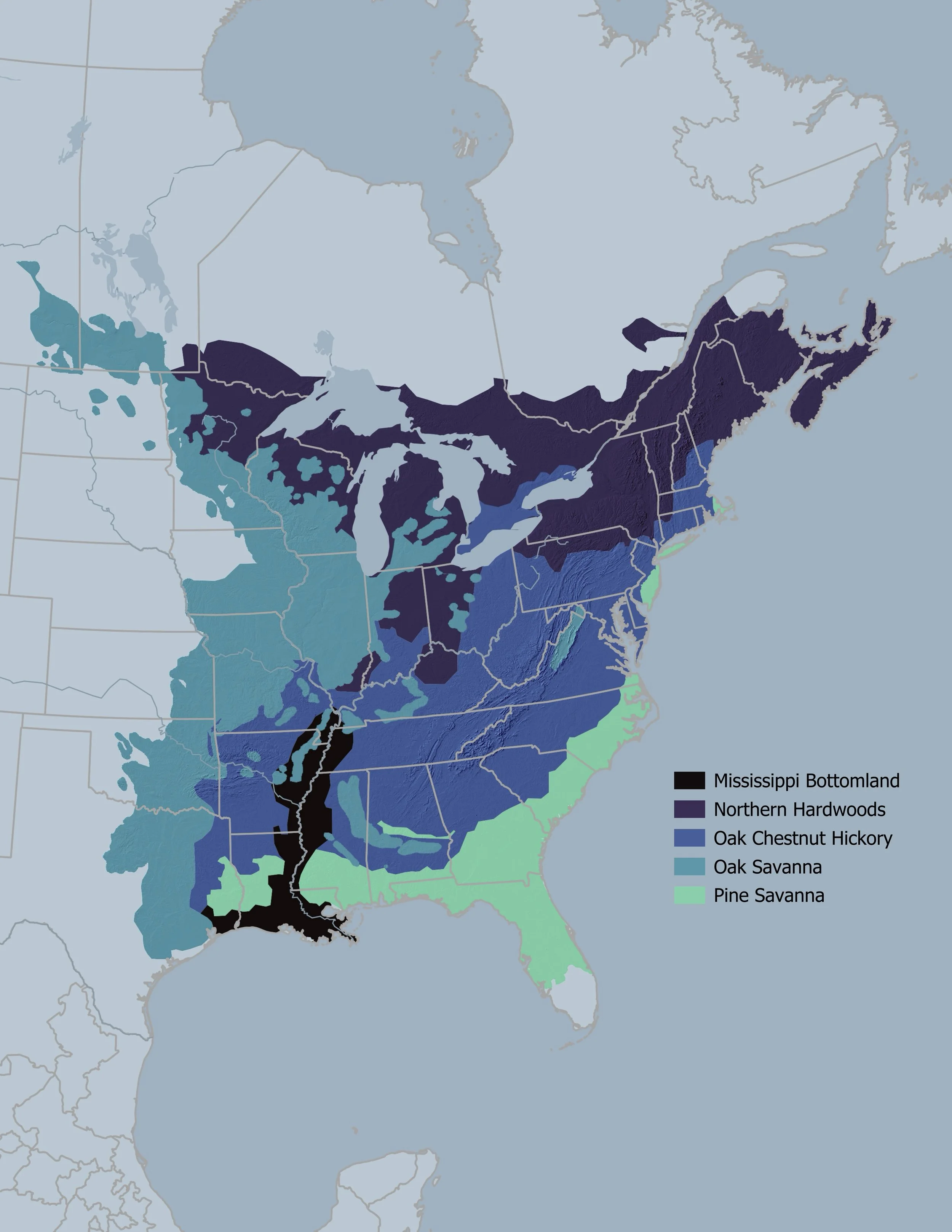
Map courtesy of Sebastian Gutwein of Regenerative Design Group